God Knows His Ultimate Plan

Ephesians 1:9-10

New Living Translation

9 God has now revealed to us his mysterious will regarding Christ—which is to fulfill his own good plan. 10 And this is the plan: At the right time he will bring everything together under the authority of Christ—everything in heaven and on earth.

What does Ephesians 1:9 mean?

Part of God’s wisdom (Ephesians 1:8) was to reveal or “make known” to believers “the mystery of his will.” Paul uses “mystery” more in Ephesians than anywhere else in Scripture (Ephesians 3:3, 4, 6, 9; 5:32; 6:19). This concept is often misunderstood. Paul’s focus is not on some mystical or self-contradictory approach, but simply on something which had been unknown in the past. In this case, a mystery of the past has now been revealed, with Gentiles coming to faith through the coming and resurrection of Christ (1 Corinthians 15:3–11).

This revealed mystery is also “according to his purpose.” Paul had already referred to “purpose” in verse 5 and will mention it again in verse 11. In Ephesians 3:11 Paul talks about God’s “eternal purpose,” while in Ephesians 6:22 Paul speaks of his own purpose in sending Tychicus to encourage his readers. God’s purpose referred to in Ephesians 3:9 was “set forth in Christ.” It was not of human creation or wisdom. Only God could design and implement such an amazing, well-orchestrated plan to bring forth His plans and ultimately bring greater glory to Himself.

Context Summary

Ephesians 1:3–14 praises God for the blessings He has provided. Paul ties together the ideas of predestination, God’s glory, the salvation of His people, and the rights we have as children of God. In particular, believers are blessed because God chose, before creation, to save us. That salvation came at a great cost: the death of Jesus Christ. As children of God, we can be confident that God will give us what He has promised: namely, an eternity with Him in heaven.

Chapter Summary

The first chapter of Ephesians contains two main passages. The first describes the blessings Christians have been given as a result of our salvation through Christ. Paul explains these through praises directed to God the Father. The second section both commends the Ephesians for their reputation, and prays that Christ would bring them into an even fuller and more aware faith

Verse Thoughts

The coming of the Messiah was no hidden mystery, for it was foretold by the prophets of Israel, but God had kept secret one peculiar aspect of His marvellous plan, which He had purposed in Himself before the world was created.

The mystery, that was kept hidden from men and angelic beings alike, was that the unsearchable riches of God’s grace, which He purposed towards whosoever would trust in His only begotten Son (whether Jew or gentile, male or female, old or young bond or free), were to become part of the mystical body of Christ, which is the Church.

It was Paul to whom this great secret was revealed – for the church, which is the body were to become God’s heavenly people, while the nation of Israel will one day be restored as God’s earthly people. The ‘heavenly people’ are to engage in a spiritual war, to demolish spiritual strongholds in high places, so that God’s ‘earthly people’ may receive the earthly inheritance promised to Abraham, Isaac and Israel.

God in His wisdom and kindness, determined to keep the church a mystery, for had Satan and his demonic forces known that God’s plan was to secure back His heavenly realm by means of the Church, they would not have crucified the Lord of Glory.

Praise God that we who trust in Jesus are the joyous recipients of this marvellous mystery that was kept hidden in ages past.. but now has been revealed to us, through the apostle Paul – according to His pleasure, which God purposed in Himself – that in the dispensation of the fullness of times He might gather together all things – IN CHRIST.

Source: https://dailyverse.knowing-jesus.com/ephesians-1-9

Live In Christ By Faith

Hebrews 11

In my last writing I spoke of how we were taught to live In Spirit by the Holy Ghost by Jesus it brings me to one of my favorite readings of the Bible Hebrews 11 this and psalm139 been my favorite passages since I was 9 I am now 43 they have walked my entire faith journey with me as I was saved baptized in the Holy Spirit and officially baptized into the church when I 16 these scriptures have always spoken to me and remained by my side on the travel into the unknown by faith

Into The Unknown that is exactly what God is reserving for us he’s wanting us to live on the unknown knowing and leaning on what He has taught us in his words and stand strong

Great Examples of Faith

Faith shows the reality of what we hope for; it is the evidence of things we cannot see. Through their faith, the people in days of old earned a good reputation. By faith we understand that the entire universe was formed at God’s command, that what we now see did not come from anything that can be seen.

Hebrews 11

New Living Translation

Great Examples of Faith

11 Faith shows the reality of what we hope for; it is the evidence of things we cannot see. 2 Through their faith, the people in days of old earned a good reputation.

3 By faith we understand that the entire universe was formed at God’s command, that what we now see did not come from anything that can be seen.

32 How much more do I need to say? It would take too long to recount the stories of the faith of Gideon, Barak, Samson, Jephthah, David, Samuel, and all the prophets. 33 By faith these people overthrew kingdoms, ruled with justice, and received what God had promised them. They shut the mouths of lions, 34 quenched the flames of fire, and escaped death by the edge of the sword. Their weakness was turned to strength. They became strong in battle and put whole armies to flight. 35 Women received their loved ones back again from death.

You see Jesus Christ already was aware that there were going to be dishonest and dishonorable humans who would go on to become false teachers and non believers and he put his plan to work in this he wants us to learn to trust living by faith and spirit knowing we all already know the truth Christ taught us before he left earth telling us to live in spirit by the Holy Ghost let the truth be told live honorable to God by faith and spirit you already know the truth

39 All these people earned a good reputation because of their faith, yet none of them received all that God had promised. 40 For God had something better in mind for us, so that they would not reach perfection without us.

https://enduringword.com/bible-commentary/hebrews-11/

What does Hebrews chapter 11 mean?

Hebrews chapter 11 dives deeply into the writer’s application of all the information given so far. Chapter 10 ended with both a warning and a word of encouragement. That encouragement specifically referred to “those who have faith,” in contrast to “those who shrink back” (Hebrews 10:39) Here, in this passage, the writer gives a direct definition of faith, along with numerous examples to make his meaning crystal clear.

Faith, according to the Bible, is not blind. More than half of the verses in the book of Hebrews are dedicated to explaining reasons and evidence to accept the new covenant in Jesus Christ. Nor is faith gullible, or senseless. Instead, godly faith is exemplified by trust. That trust is based on what we know of God, relying on Him for the things we do not know. In particular, godly faith looks forward, from an eternal perspective, and produces obedience, even in the face of hardship. God takes what we cannot see, or cannot understand, and uses it to make good on His word. Since faith relies on what we’ve seen of God, and trusts Him for the future, it becomes the “assurance of things hoped for, the conviction of things not seen” (Hebrews 11:1–3).

Most of the rest of the chapter is devoted to giving examples from Scripture to clarify this particular definition of faith. In each case, the same basic pattern emerges. These figures knew enough about God to trust Him, and so they obeyed, even when they were faced with doubts or challenges. In some cases, this meant trusting that God’s promises were ultimately meant to be fulfilled in eternity, not necessarily their own lives.

In the first set of examples given, the writer focuses on examples of general, life-long trust in God. Abel and Enoch are strongly contrasted in the way their earthly lives ended. Abel was murdered (Genesis 4:8), while Enoch was taken by God without even experiencing death (Genesis 5:23–24). Part of the lesson here is that what happens in our earthly lives is not the end of God’s plans for us, nor does it represent everything He intends for our future. Others, such as Noah, Abraham, and Sarah, are also referenced as examples of those who honored God in their lives, and were in return honored by God (Hebrews 11:4–12).

After bringing out these early examples, the writer then points out that godly faith is not aimed at our earthly lives, but at eternity. People like Abraham were able to trust in God, in part, because they were not explicitly concerned with this life. They were looking forward, but beyond even their own death, to “the city that has foundations” (Hebrews 11:10), and to a “better country, that is, a heavenly one” (Hebrews 11:13–16).

The next set of examples focuses on those who trusted in God in the midst of immediate, direct personal challenges. Abraham is mentioned again, in the ultimate example of godly faith. When ordered to sacrifice Isaac, Abraham obeyed. This obedience was driven by his prior experiences with God, and the Lord’s ability to prove Himself righteous, even when Abraham could not see all ends. Other patriarchs are also mentioned, for their willingness to pass along God’s words, and God’s blessings, to their children. Moses, also, is mentioned, as one who was willing to endure hardship for the sake of honoring God (Hebrews 11:17–28).

The writer also refers to the crossing of the Red Sea, the conquest of Jericho, and the rescue of Rahab as examples of victory earned through faithful obedience to God (Hebrews 11:29–31).

At this point, the book of Hebrews launches into one of the most inspiring passages in Scripture. Without giving detail, the writer reminds his readers of Old Testament heroes, such as the Judges, the prophets, and David, who accomplished amazing feats as a direct result of their faith. Those achievements are listed, also in a rapid-fire style, culminating in the ultimate example of victory: resurrection from death (Hebrews 11:32–35).

Next, this passage reminds the reader that these same heroes of the faith suffered many earthly hardships. They were willing to endure persecution, torture, and even death, rather than forsake their obedience to God (Hebrews 11:36–38).

And yet, those same heroes are still waiting for God to grant them the full promise of His word. This is for a humbling, crucial reason: us. In order to grant those still living the opportunity to share in that same reward, God is allowing us time to hear, to respond, and to obey (Hebrews 11:39–40). The first words of chapter 12 flow directly from this theme, encouraging the reader to “hold fast” despite hardship, and to face whatever circumstances might occur. Christ, our ultimate example, did the same: obediently enduring pain and suffering, because He knew the reward which was waiting in eternity (Hebrews 12:1–2).

Book Summary

The book of Hebrews is meant to challenge, encourage, and empower Christian believers. According to this letter, Jesus Christ is superior to all other prophets and all other claims to truth. Since God has given us Christ, we ought to listen to what He says and not move backwards. The consequences of ignoring God are dire. Hebrews is important for drawing on many portions of the Old Testament in making a case that Christ is the ultimate and perfect expression of God’s plan for mankind. This book presents some tough ideas about the Christian faith, a fact the author makes specific note of.

Chapter Context

Up to this point, the book of Hebrews has given extensive evidence proving that Jesus Christ, and the new covenant He brought about, is God’s ultimate plan for mankind’s salvation. Chapter 10 provided an additional warning about the danger of falling away from this truth. Chapter 11 begins by clarifying the meaning of the word ”faith,” primarily by listing examples of Old Testament figures who exemplify it. The ultimate application of this knowledge should be a motivation to ”hold fast” to the gospel, despite hardships. That encouragement is a major theme of chapter 12.

Verse Thoughts

The good news of salvation and life eternal is by grace alone through faith alone in Christ alone. Whether Old Testament saints or New Testament believers, the only way to access this free and eternal gift from the Father is to trust in His Word and believe in His Son. 

Faith is simply having the confidence that the future things God has revealed in His written Word, will unquestionably happen. The reformation verse that shattered corridors of Christendom was, “the just shall live by faith” – the righteous man shall live by faith – the godly man, the virtuous woman, the justified sinner, the maturing believer, are to all live by faith as well as being saved by faith. 

A living faith in God’s Word and the confident hope in His promises are two graces that embrace each other in love – at the foot of the Cross. This is not a ‘Que Sera, fingers-crossed and-hope-it-happens’ type of faith. This is the faith that accepts without question that the Word of God is entirely dependable and is an indisputable fact.

This is the faith that unquestioningly takes God at His Word, knowing that all He has promised to us in Christ is more secure than the rising of the morning sun and more certain than the daily passage of time. It is the firm persuasion, unshakable confidence, and indisputable expectation, that all God has said, in and through His WORD, is established forever and does not take refuge in the a ‘maybe’ or a ‘perhaps’.

It is an objective faith that is secured to the knowledge that our redemption rests on Who Christ is, and what He has already done on the Cross on our account. Our faith is not on who we are or what we have done to commend ourselves to God, but on Christ and His accomplishments. Objective faith is not based on sight or sense but rests its case in the arms of God’s Word of Truth.

Faith is not based on experience, nor calculated through reason. True faith is anchored on scriptural facts. It is beyond man’s intellect and cannot be penetrated through reasoning or discovered through scientific ‘proof’. It has nothing to do with personal opinion or impressions. It is beyond the dimension of human thought because it is the substance of facts that are conceived in the mind of God. 

God is not a man, so He does not lie. The Lord is not a fallen being, so He does not flirt with fantasy or feasibility. He does not change His mind and has never spoken a word that He has failed to act upon. Has he never made a promise that has not been carried through to its fulfilment, and it is incumbent on us to know what His Word says and to believe the promises He has given.

The eye of faith sees beyond our present reality and places its feet firmly on divine revelation given by almighty God, through the Word-made-flesh. It believes God’s Word of truth in the pages of Scripture, which was written for our learning, instruction, encouragement, and hope. The heart of faith enables us to treat as reality those things that are unseen, even when circumstances of life appear to contradict the truth of God’s Word.

All that God has revealed to us through holy men of God is just and good and true, and Scripture is designed to be a sure foundation upon which to build. It has nothing in common with so many superficial apologies for faith, based on sight, experiences, opinions, fancies, dreams, or imaginations that excite the soul, feed the flesh, and pander to the human ego. Without faith it is impossible to please God and Jesus said, “blessed are those that have NOT seen – and yet have believed.”

May the hope we have in Christ and the faith we have in God be built on the truth, of His Word and grounded on a sure conviction. May we never stumble when situations seem to go amiss, and may we be firmly persuaded that, “He who started a good work in each of our lives is well able to bring it to completion.”

Source: https://dailyverse.knowing-jesus.com/hebrews-11-1

The True Teacher is Jesus The Messiah, Waymaker, Promise keeper

2 Timothy 4:3

New Living Translation

3 For a time is coming when people will no longer listen to sound and wholesome teaching. They will follow their own desires and will look for teachers who will tell them whatever their itching ears want to hear.

When Jesus The Messiah first was sent to earth in flesh and resurrection there used to be a time when everyone wanted to hear his stories and teachings now people see only stories and teachings of his taught from others and they question what they already know so instead of searching for that which is true and they already know they search for just a sound response in and wherever they can get one but those are given by cons and false teachers they now will listen to what it is our own heart wants to hear not what was taught by Jesus The Messiah which we have always known true

The true teacher is Jesus The Messiah, Waymaker, Promise keeper

For a time is coming when people will no longer listen to sound and wholesome teaching. They will follow their own desires and will look for teachers who will tell them whatever their itching ears want to hear.

What does 2 Timothy 4:3 mean?

The time when people would not listen to sound teaching and instead amass false teachers was not far away, according to this reference. . Paul was concerned that after his death, false teachers would arise in Ephesus and turn believers from the true faith into error and myths. Paul specifically addresses four concerns in this verse and the next that would lead people away from God’s truth.

The first two concerns are in this verse. First, people would grow tired of the true gospel and reject it. Instead, they would turn in other directions, looking to replace sound or healthy teaching. This is to be expected when the gospel message begins with a humbling, difficult thought: we are imperfect and in need of saving.

Second, instead of following godly teachers, people would choose to follow teachers who told them what they liked to hear, rather than what was true. The idea of “itching ears” may be that of twitching or moving ears that sought something different from the traditional, true gospel message.

The next verse will add two more descriptions of those who turn away: they will avoid truth, and they will follow myths.

Context Summary

Second Timothy 4:1–8 contains Paul’s last ministry instructions to Timothy. Paul knows that he will not survive his current imprisonment. So, he clearly and boldly charges Timothy—commands him—to hold to the faith he has seen and lived. He can do this knowing that Paul has faithfully served God, expecting the heavenly rewards given to all of God’s followers. The poignant tone of this passage is made even more bittersweet by the long friendship these two men have shared.

Chapter Summary

Paul introduces himself, then recaps Timothy’s path to becoming a minister. He reminds Timothy of how his family brought him up in the faith, and then how Timothy served faithfully with Paul in the past. Paul then focuses on two primary ideas. First, that Timothy’s background in the faith should give him the courage to stand fast against hard times. Second, that Timothy should use that courage to defend the truth of the gospel message. Paul will use these points and examples as the foundation for the rest of his letter

Verse Thoughts

Second Timothy is the last of Paul’s epistles. He was a prisoner in Rome, and knew that his life was nearing its end. Paul also knew that after his departure, grievous wolves, would arise in the body of Christ, and would not spare the little flock of God.

It is not surprising, therefore, that Paul gave significant, advanced-warning about treachery within the Church, and seriously cautioned Timothy against false teachers, doctrines of demons, apostasy within the Body of Christ and ungodly heresies infiltrating the little flock of God.

Earlier we discover Paul exhorting Timothy to righteous living, Christian fidelity, fulfilling his ministry as a pastor and ensuring that he continues to be a worthy workman – approved of God.

Paul encouraged Timothy to flee from evil lusts, and to preach the whole council of Christ.. and he further expressed his grief over certain men, who were distorting the pure gospel of grace, and destroying the faith of some, by teaching that there was no resurrection!

But in this final section, Paul reiterates the serious warning of godlessness in the last days, where evil men will go from bad to worse – deceiving others, and being deceived themselves… For the time will come when they will not endure sound doctrine, is Paul’s heart-breaking pronouncement.

They will want to have their ears tickled, with a watered-down and compromised gospel, he continues, and they will accumulate for themselves teachers, who say the things they want to hear, by preaching a feel-good credo, instead of teaching the plain, truth of the gospel of grace, about sin and salvation.. and about Jesus Christ, as the one and only way to be justified by God.

The closer we get to the close of the Church age, the more we recognise this prophetic word from Paul, coming to pass. We see an evolving gospel, which focusses on a feel-good factor and we hear of ungodly aberration in the Body of Christ. Some teach a prosperity gospel, with its accompanying, unbiblical ‘word of faith’ declarations and positive proclamations, together with an emerging church, where Scripture is altered to tickle the ears of carnal men and foolish women.

Some falsely teach a universal salvation.. where everyone is eventually saved, or that there are many ways to God. Certain groups proclaim that we all worship the same deity, while others promote a social gospel and embrace polytheism, eastern mysticism, transcendental meditation, centering prayer or ‘Chrislam’. There are also those that follow secular philosophies and promote an unbiblical worldview – where Bible prophecy is ignored or twisted.. and extra biblical teachings are promoted, while others are encouraged in a purpose-driven life, through a socialite gospel.

Many like to focus on social changes in the community, while denigrating the gospel of Christ, the salvation of the lost and spiritual maturity, while others continue to teach an equally concerning works-based religion, rather that a grace-based faith, which too often promotes the unbiblical teaching called, ‘replacement theology – which incorrectly teaches that the Church has replaced Israel.

Paul warned that the time would come when they will not endure sound doctrine, and would want to have their ears tickled, with a watered-down and compromised gospel, and accumulate for themselves teachers – having itching ears. How reflective of Christendom today, is this warning from Paul.

Let us beware of the many false teachers, doctrines of demons, extra-biblical revelation, fascination with angels and the plethora of ungodly teachings that are infiltrating Christianity today – lest we be drawn away into unscriptural teachings and an unbiblical worldview. Let us study to show ourselves approved unto God and take to heart the whole, council of God – so that we are not led astray, in these increasingly evil and godless times.

Source: https://dailyverse.knowing-jesus.com/2-timothy-4-3

My Prayer

Heavenly Father, keep me low at the cross and looking to Jesus. Protect my heart and mind from the huge numbers of false teachers and unbiblical doctrines that are flooding the church today. Help me to identify false teachings and distorted doctrines.. and I pray that I may flee from the increasing amount of ungodly, unbiblical and extra-biblical teachings, that are flooding Christendom today. I pray that I may live worthy of my calling in Christ, and live my life to His praise and glory, in Jesus name I pray, AMEN.

Source: https://dailyverse.knowing-jesus.com/2-timothy-4-3

The Magnificence Of The Immense Universe

Psalm 19:1-2

New Living Translation

Psalm 19

For the choir director: A psalm of David.

The heavens proclaim the glory of God.

    The skies display his craftsmanship.

Day after day they continue to speak;

    night after night they make him known.

The heavens tell about the glory of God. The skies announce what his hands have made. Each new day tells more of the story, and each night reveals more and more about God’s power.

Verse Thoughts

The magnificence of the immense universe declares the wonderful handiwork of our Creator God. It tells of the amazing work of His creative hand. It speaks to every person who has ever lived on this terrestrial globe.. of a caring God, Who created the heavens; formed the earth and fashioned all that was made in those six astonishing days of creation.

Not one person could be indifferent to the heavenly glories of the day-time sky and the countless wonders of the stunning night-time sphere.. as we gaze on the sun and moon and twinkling stars, which God in His grace placed into the heavens on the third day of creation. And God placed them there for signs and seasons.. for days and for years. They were created to shed their radiant glow and life-giving warmth onto the earth. They were fashioned to rule the day and establish the night, as a perpetual reminder of God’s eternal goodness and His immeasurable greatness.

It was David, the shepherd king who was moved by the splendour and majesty of God’s handiwork to pen this hymn of praise to his Creator God. No doubt David had watched in wonder as the planets danced across the night sky, or as the fruitful season of harvest rolled round to the lush springtime of new birth. No doubt David also recognised the unmistakable signature of his faithful God, Who was the good Shepherd, Who provided all he needed, led him in the paths of righteousness for His name’s sake, and promised a table of plentiful supply in the face of his bitter enemies.

The wonder of the heavens tell forth the glory of God and the wider expanse of God’s amazing creation continues to declare day by day of the amazing work of God’s creative hands. Creation is one of two “books’ (creation and conscience), that God has given to every man born of woman and every woman begotten of man. These ‘scrolls’ tell forth the wonders of His name. The shocking truth is that man in his pride and foolishness has refused to read, recognise and honour the signature of His Creator-God.. in His astonishing book of Creation and the inner witness of his own God-given conscience.

Man in the ignorance of his own folly has ignored the vast quantities of evidence that.. “in the beginning God…. Instead they have changed the glory of the incorruptible God into images made in the likeness of corruptible man – bowing down to false gods made like the sun, worshiping the moon and creating images in the likeness of birds, creatures and creeping reptiles!!

All men have been given irrefutable proof of God and His creative power through both creation and their own God-given consciences.. but most have failed to read, recognise and respond to the exterior evidence in the creation.. and the inner witness of their their own.. God-given consciences. Man through his foolish pride and wilful rebellion has ignored the outer witness of creation and has allowed the inner witness of conscience to become seared and irresponsive to God’s declaration of His own mighty works.

We have also been blessed to receive a third “book’ from our Creator God – The Holy Scripture, which details God’s amazing plan of Salvation – that fallen man can be saved by grace through faith in the death, burial and resurrection of God’s only begotten Son.. Who laid aside His heavenly glory to be born into this sinful, rebellious race of man.. so that all who believe in His sacrificial death and glorious resurrection – would not perish but have everlasting life..

Source: https://dailyverse.knowing-jesus.com/psalm-19-1

My Refuge In Christ

Psalm 91:2

New Living Translation

This I declare about the Lord:

He alone is my refuge, my place of safety;

    he is my God, and I trust him.

We are taught to love one another, be kind and respecting to others

And we know that the lord fully loved and trusted his father and was made in the image of God as we are made in the image of Christ

He who dwells in the shelter of the Most High will rest in the shadow of the Almighty. I will say of the LORD, “He is my refuge and my fortress, my God, in whom I trust.” Surely he will save you from the fowler’s snare and from the deadly pestilence.

Verse Thoughts

The truths that are intertwined within this beautiful Psalm are precious promises that every one of God’s blood-bought children are able to claim as their own. However, the majority of theologians correctly identify this section as a Messianic psalm… for the Lord Jesus is the only One Who truly dwells in the shelter of the Most High. He is the Man of men, Who abides in the shadow of the Almighty.

When the eternal Son of God was born into His own creation as the perfect Son of Man, He lived His life dwelling in the shelter of the Most High. He abode in the shadow of the Almighty. He depended entirely on the Father as His refuge and fortress and demonstrated to us all how a man should live – by trusting God in all things. In many respects, the Lord Jesus is the only Man Who can legitimately claim God as His refuge and fortress – His God in Whom He trusted implicitly. But praise God that even when we fail, “GOD IS still our refuge and our strength,” because of our position IN Christ.

The Lord Jesus is the one and the only Person Who could honestly claim God as His refuge and fortress – and He did this on our account because He went to the Cross for us – in obedience to His Father’s will. We who are saved by grace through faith, find our everlasting refuge in Christ, Who took the punishment for our sin and became our strong Fortress, our everlasting Refuge, and the Rock of our salvation.

Jesus is the only One who can legitimately confess that the Lord is My God, in Whom I place my trust, and Who will deliver me from the snare of the fowler and the deadly pestilence. Throughout His life, the Lord Jesus was hidden under the shadow of His Father’s wings, in Whom He sought refuge. God was His hiding place Who preserved Him from trouble, and because we are IN Christ, we can also sing songs of deliverance for God’s faithfulness and favour towards us. We can also claim God to be our mighty Shield and an eternal Bulwark.

Throughout His earthly life, the Lord Jesus maintained ongoing and never-failing fellowship with His Father. He only did the things which He heard from His Father. He only did those things that He saw His Father doing. Throughout His earthly ministry, the Lord Jesus was ready and willing to say, “Thy Will, not Mine be done.” He was able to trust the Lord with every circumstance of His life, for His undivided hope was in God.

Jesus was free from every fear because His trust was in God, and in the power of the Almighty, He fulfilled all righteousness and became qualified to become the perfect, sinless sacrifice for the sake of mankind. And we are called to imitate the way He lived. We are to hide under the shadow of His wings every moment of the day and say to Him – You are my Refuge and Fortress. You are my God, in Whom I trust.

Although the Lord Jesus was fully God, He lived His entire life as a Man. He lived His life and faced His death in utter and total dependence on His heavenly Father for everything. Although the Lord Jesus was the eternal God, He lived His life as a perfect Man, setting an example to every member of the human race… showing every child of God how our heavenly Father expects each one of us to live. 

No doubt the man who penned this Messianic psalm was himself convinced of the wonderful security that is found in the Lord his God because his faith was credited to him as righteousness and he could legitimately confess that his trust was in the Most High God – the Almighty King of the universe Who is signified as the Sovereign Ruler of all and the Divine Protector of those that believe on His name.

But the psalmist was inspired to write words that would look forward to the God-Man, Who was wounded for our transgressions and bore the sin of the world on His shoulders, so that all who trust in Him can identify with His death, burial, and resurrection to a new life, and state confidently, “He who dwells in the shelter of the Most High, will abide in the shadow of the Almighty. I will say to the LORD, ‘You are my refuge and my fortress, my God, in whom I trust!”

Source: https://dailyverse.knowing-jesus.com/psalm-91-2

A God Of Love And Mercy

Isaiah 41:10

Fear not, for I am with you; be not dismayed, for I am your God; I will strengthen you, I will help you, I will uphold you with my righteous right hand.

Do not be afraid

I am with you

Be of no discouragement

I am your God

I will give you strength and help you

I will uphold you with my righteousness of my right hand

Verse Thoughts

It has been said that the comforting words, Fear Not, appear in the bible 366 times, one for each day of the year, plus one for leap year. But no matter how many times these words of encouragement appear, let us always remember that they are spoken by the Creator of the Universe. He is the one Who tells His children not to fear, nor to be discouraged, because He is our God and that should be sufficient. We should simply take Him at His word.

Faith in His Word is what God desires of us all and are warned that unless we trust His word we can’t please Him. But the Lord is gracious to us for He knows that we are but dust. He knows that doubts and discouragement can be triggered by so many things that mar our lives, and so He often expands His words of comfort with a beautiful post-script, underlining and emphasizing His loving-kindness. There are three such extensions in this beautiful verse that was first given to Israel.

Firstly, we are not to fear for He has promised to strengthen all that are His and the Jesus amplifies this truth to Paul, when He tells him that Christ’s strength is sufficient for His strength is made perfect in our weakness.

Secondly, the Lord continues, that as well as having His strength for all we need, He will be an ever-present help in trouble. Indeed, the Lord Jesus Himself promised, Lo I am with You always, even to the end of the age and furthermore He even sent His indwelling holy Spirit to be our present Helper and our resident Comforter at all times and in all places.

Thirdly, His reassurance stretches out His arms of love still wider, with the pledge to uphold us with His righteous right hand and to prevent our steps from slipping by enfolding up in His arms of righteousness.

YES – Christ is our righteousness, and Christ is our ever-present help in time of trouble, and it is Christ Whose grace is always sufficient for all our needs for Christ is our covering – how then can we fear, if God be for us who is there to fear? Whether the comforting words, Fear Not, appear in the bible 366 times of simply once, we should hearken to His word and trust His promises for His word is trustworthy and true.

Source: https://dailyverse.knowing-jesus.com/isaiah-41-10

The Blessing of His Presence

This summer, we are going to dive into how God blesses us and how we can cultivate lives that receive all the blessings He has in mind for us. What amazing things does our God have in store? How can we live lives that invite and walk into those blessings regularly?

We have to lay a foundation for those blessings, like tilling up the garden bed to get it ready to receive the seeds. We have to turn the soil of our thought patterns and habits. This allows us to see where we have become hard ground or allowed weeds to grow up and choke out His blessings.

Working, but not alone

But, we don’t have to work at it alone!

“Do not fear, for I am with you; do not be afraid, for I am your God. I will strengthen you; I will help you, I will hold on to you with my righteous right hand.” Isaiah 41:10 (CSB)

God will be right there with us. AND, we are here for each other. A community of Christ-followers, ready to lift one another up.

Who is this God who will be with us?

“The Lord passed in front of him [Moses] and proclaimed: The Lord – the Lord is a compassionate and gracious God, slow to anger and abounding in faithful love and truth, maintaining faithful love to a thousand generations, forgiving iniquity, rebellion, and sin.” Exodus 34:6-7a (CSB)

“For nothing will be impossible with God.” Luke 1:37 (CSB)

Our God is full of love and mercy. He is slow to anger. He forgives and forgives and forgives. And, nothing is impossible for Him. He can do the biggest impossible dream you can imagine. The highest hurdle, the largest obstacle can be overcome.

That is Who is with us and will never leave us.

The first blessing we need to grasp hold of is the blessing of His presence. Out of His presence flow all other blessings.

God’s promises

What does God say He will do?

1. “I will strengthen you.”

Ouch! When I read this, I thought about working out. When we want to gain strengthen, there is a process. We have to work those muscles, tearing them down and building them up. The strengthening process is uncomfortable and won’t feel like blessing at first. This is the time to trust and lean into God’s presence.

2. “I will help you.”

Whew! We need God’s help to stay on course when the strengthening storms come. God can use the bad things of a fallen world to benefit us and build our character if we will trust His plan and accept His help.

3. “I will hold on to you with my righteous right hand.”

I have a confession to make. I imagine God saying this with a surfer dude’s voice. “My righteous right hand, man!” It is funny to think about, but there is nothing funny about God holding us in His hand. He will not let go of us. He will never give up on us. With His hands that can hold the whole world, He is holding you and me.

The Lord Will Provide

Psalm 23:1

New Living Translation

Psalm 23

A psalm of David.

The Lord is my shepherd;

    I have all that I need.

he restores my soul. He guides me in paths of righteousness for his name’s sake. Even though I walk through the valley of the shadow of death, I will fear no evil, for you are with me; your rod and your staff, they comfort me. You prepare a table before me in the presence of my enemies.

Sheep guarded by a skilled shepherd are led to food and water, and protected from harm. In the same way, David praises God for giving him peace. The knowledge of God’s protection and provision are a great comfort. This psalm incorporates themes of supply, defense, assurance, and care from God.

What does Psalm 23:1 mean?

These words are some of the most-frequently quoted in the entire Old Testament. Even those unfamiliar with the Bible may recognize this verse, which has been used in countless ways over the ages.

In this verse David expresses his confidence in the Lord as his shepherd. The word for “LORD” in this verse is from a Hebrew term known as the tetragrammaton. This is four letters: yodh, he, waw, he; in English these are essentially YHWH. This is often transliterated as Yahweh or even Jehovah. This is the biblical name of the covenant-keeping God of Israel.

David knew by personal experience that Yahweh shepherds His people. He cares for all their needs. When he was a shepherd boy, David cared for his sheep, making sure all their needs were met. In similar fashion the Lord cared for David. David lacked nothing. Believers, too, can be sure the Lord, the Good Shepherd, meets all our needs. He listens to our prayers, and if we call on Him, we will receive His grace and help in a time of need (Hebrews 4:14–16).

An interesting name for the Lord is found in Genesis 22:14. Abraham had been commanded by God to take Isaac and sacrifice him. When Isaac inquired of his father Abraham where the lamb was for the burnt offering, Abraham told him the Lord would provide the sacrifice. As Abraham prepared to sacrifice his son, the angel of the LORD stopped him. Abraham had demonstrated his faith in God. The Lord provided a ram that was caught in a thicket by its horns as a sacrifice instead. Abraham promptly sacrificed the ram and called the site of the sacrifice, Jehovah-Jireh, meaning “The Lord will provide.”

Context Summary

Psalm 23:1–3 extolls the blessings bestowed on David by the Lord, his personal shepherd. The scene is peaceful and personal. In John 10:11 Jesus identified Himself as the Good Shepherd. He does for His sheep what David describes in Psalm 23:1–3. He leads his sheep (John 10:3–4); guides them to pasture (John 10:9); restores their souls (Joh 10:10); and protects them (John 10:11–15).

Chapter Summary

David celebrates the protection and guidance of God. Sheep guarded by a skilled shepherd are led to food and water, and protected from harm. In the same way, David praises God for giving him peace. The knowledge of God’s protection and provision are a great comfort. This psalm incorporates themes of supply, defense, assurance, and care from God.

Verse Thoughts

It was by divine design that this Psalm so beautifully describes the Lord God as our great and caring Shepherd, for although it is often used as great comfort at a time of death or bereavement – it is equally a Psalm that points to the Lord Jesus Christ as our sustenance and support in every season of our lives. For the Lord is our Provider and Peace; the Lord is our Strength and Stay: the Lord is our Righteousness and our Reward – the Lord is our Sanctuary and our Shepherd.

It was by divine design that David personalised this Psalm to read: the Lord is MY Shepherd. He is indeed your Shepherd and He is our Shepherd and He is the Shepherd of all that love and trust Jesus as Saviour, for we are the sheep of His pasture and none can pluck us out of His hands. But we can rightly say the Lord is MY Shepherd – for He is with each of us every step of the way, to lead and to comfort – to guard and to guide. He is with us in the good times and throughout those difficult days and He has promised never to leave us nor forsake us but to be our constant Companion and our ever-present Comforter.

It was by divine design that the Lord Jesus is so beautifully represented as a tender shepherd – the Good Shepherd Who gave His life for His sheep – the Great Shepherd Who loves His own with a deep compassion – the Chief Shepherd that rescues His scattered straying – stupid sheep and gives them life – eternal life… abundant life. Truly we can say in confidence: the Lord is my Shepherd I shall not want. He lets me rest in green meadows; He leads me beside peaceful streams. He renews my strength and guides me along right paths, which brings honour to his name.

Even when I walk through the darkest valley, I need never be afraid, for Jesus is close beside me. His rod and staff protect and comfort me. He prepares a feast for me in the presence of my enemies. He honours me by anointing my head with oil and my cup overflows with multiplied blessings. Surely His grace and goodness and unfailing love and mercy will pursue me all the days of my life, and I will dwell in the house of my LORD forever.

Source: https://dailyverse.knowing-jesus.com/psalm-23-1

Do Not Boast Tomorrow Is Not Promised

Proverbs 27:1

New Living Translation

27 

Don’t brag about tomorrow,

    since you don’t know what the day will bring.

Proverbs 27 1

Let another praise you, and not your own mouth; someone else, and not your own lips. Stone is heavy and sand a burden, but provocation by a fool is heavier than both. Anger is cruel and fury overwhelming, but who can stand before jealousy? Better is open rebuke than hidden love.

Don’t speak in ill words about the future of tomorrow words hold arrows and you don’t know what shall even come tomorrow let praises come to your heart from others do not praise yourself let the praises come from another’s lips of the words they speak your known journey is today yesterday is forgiven and tomorrow is not promised you hold the key to the future you hold use it wisely don’t brag about tomorrow since you don’t know what it holds

Your known future is today. Consider it. You may not be alive tomorrow, and you do not know what will happen tomorrow. God has given you today, and you should use it wisely. God holds your future in His hand, so plans should be humble and modest.

Tomorrow might bring rain, your loss of a job, your spouse leaving, an auto accident, a diagnosis of cancer, or even death. You cannot know or stop any of these events. Your perspective on life and your future could be changed drastically in the next few hours.

You will never have today back. Who should you love in case there is no tomorrow? Who should you forgive? Who should you thank? Who should you comfort? Above all, what can or should you give God today in confession, praise, or conduct to honor Him?

You will never have today back. Guard your thoughts, words, and deeds, lest they cost you painful consequences tomorrow or guilt and grief for eternity. A successful life is a string of godly days put together. Make sure today is the brightest day in that chain.

God’s wisdom says that godliness with contentment is great gain (I Tim 6:6). Are you living today as godly as you know how, and are you content with what God has already given you? This is the way to maximize life and avoid sinfully boasting of tomorrow.

Do not loudly say what you will do in the future. In any significant statement about your plans for the future, humbly submit your life and plans with these words: “If the Lord will.” This is God’s command for your life, and any other approach is evil (Jas 4:13-16).

Do not presume to reconcile offended parties in the future. You could go to them today. Do not procrastinate about any important matters today by the foolish thought you have tomorrow. Humbly satisfy the court of heaven and earth today by using its hours wisely.

Life expectancy is based on averages, but there is no John or Sally Average. In fact, you may die young to make the average what the insurance companies say it is. If the average life expectancy is 73 (Ps 90:10), there are those that at die at 23, 53, and 93 to make it so.

Why are most surprised by death? It is a certainty that no man denies. Because there is a fatal presumption of living tomorrow! All men boast of tomorrow in various ways. And one of the common ways is to ignore death yourself even while planning on it for others.

You do not know if you will die tomorrow or what else might happen, but you will answer for every aspect of today in the Day of Judgment (Rom 14:10-12; II Cor 5:9-11). Therefore the lesson is to live godly and wise lives and submit all plans humbly to God.

What can you do? You should live one day at a time. You should count each day a gift and use it wisely to God’s glory (Ps 90:12; Rom 14:7-9). You should live and love God’s way, so that any loss tomorrow might bring will not disturb the eternal rest of your soul.

Business and other plans should be submitted to God’s sovereign will, for only He knows tomorrow (Jas 4:13-16). Confident plans without this submission are sinful. Boasting in strategic plans or budgets is not only sinful, it is stupid; such plans are mere speculations.

Jesus said, “Take therefore no thought for the morrow: for the morrow shall take thought for the things of itself. Sufficient unto the day is the evil thereof” (Matt 6:34). What precious wisdom! Do not worry about tomorrow. It will take care of itself. You have enough evil today to keep you busy. You should say, “Give me this day my daily bread.”

Fools plan on getting right with God tomorrow, but that day never comes. There are always more excuses. Felix, trembling under Paul’s preaching, told him, “Go thy way for this time; when I have a convenient season, I will call for thee” (Acts 24:25). It never came. You have today to be godly and wise – do not presume on having any other day.

Children and youth foolishly and impatiently presume on many tomorrows, for they crave imagined future pleasures rather than appreciate today. Those of middle age expect to reach old age. The old confidently believe they will outlive neighbors. Such delusions about the future are madness. The minutes reading this proverb could be your last!

Jesus told about a rich and successful man that confidently planned for many years to come, but he died that very night (Luke 12:16-21). God called him a fool for such arrogance and presumption. And you are no wiser, if you do not use today to please God.

One of the best ways to live is to consider today your last day in spiritual things. If you knew you would die tonight and immediately face Almighty God, how would you live today? Unnecessary variations from that perspective prove you are boasting of tomorrow.

Will the Lord Jesus Christ, the blessed and only Potentate, find you waiting for His surprise visit at the hour of your death or His sudden coming? You could die today. He is returning soon. Heaven and hell are of grave importance. Will you live today accordingly? Or will you make the fatal mistake of planning tomorrow and dying today?

God says, “Go ahead; make plans.” But He adds in this proverb and elsewhere, “but do not boast about them.” Never tell yourself or anyone else, “It’s as good as done,” or “This can’t miss.” Why? Because you do not even know how today will turn out, let alone, tomorrow.

https://www.biblestudytools.com/proverbs/27-1.html

Verse Thoughts

The Lord Jesus is light and life, safety and strength, purity and peace. In Him is security and salvation, for by Him sin and death has been conquered and through Him we have access the Father for He is the one way, the only truth and the revealed Word of God.

In Him we live and move have our being and through Him we are more than conquerors because He loves us, and He has send His Holy Spirit to take up permanent residence within our hearts, for He has promised, I will never leave you nor forsake you.

We are led and guided by His eternal light, which floods our soul with the divine light of a heavenly birth, so that He dispels all darkness; comforts all sorrows; calms our fears and guides us into the paths of righteousness and truth. He is not only light and salvation, but He is my light and my life, my strength and my peace, my salvation and my God.

There is nothing in heaven or earth, visible or invisible that should disturb out hearts or cause us to be afraid for He is the omnipotent Creator and all the strength of our lives and the illumination for our path, derives directly from Him.

When we put the Lord Jesus into proper perspective, and see Him for Who He truly ism our hearts should truly rejoice, for if God is for us who can be against us?

Source: https://dailyverse.knowing-jesus.com/psalm-27-1

Work Willingly With God

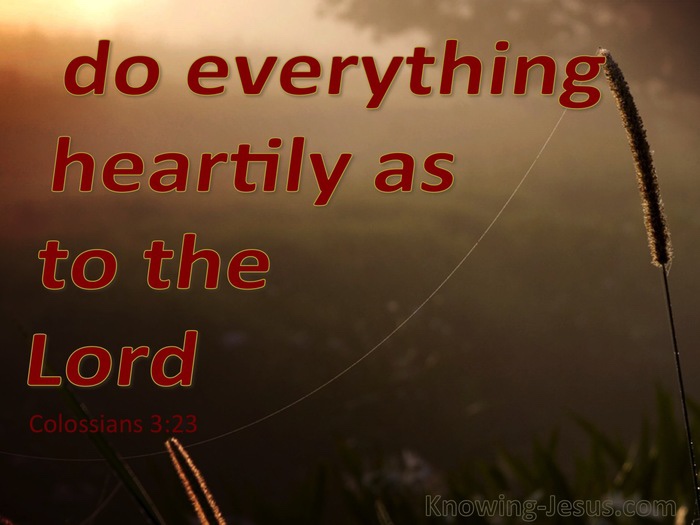
Colossians 3:23

New Living Translation

23 Work willingly at whatever you do, as though you were working for the Lord rather than for people.

What does Colossians 3:23 mean?

This verse continues Paul’s instructions to Christian “bondservants,” or slaves. The concept he presents, however, is phrased in a very general way. The principle applies to all believers, for all those we work for: serve as if serving God Himself. According to the next verse, this is for a good reason. Our ultimate rewards are with God, not the human beings we serve for only a short time.

Paul echoes his teaching from verse 17, that Christian conduct should extend to all aspects of life, not just a small set of rules. As it pertains to servants, this might include cleaning dishes or serving dignitaries. “Whatever” includes any and all contexts. Christians of all kinds are to work “heartily,” from the Greek phrase ek psyches, meaning “from the soul.” This implies the ideas of enthusiasm and passion. Demonstrating a good work attitude makes a tremendous difference in one’s personal life and in our influence on others.

Paul’s words remind us that, regardless of our station in life, God is the one ultimately judging all we do, so all of our service is really for Him. From the most mistreated slave to the highest-paid leader, every person is called to work for God’s honor. We do not work “for men” or simply earthly goals, but to glorify our heavenly Father and Master. Living for the Lord’s honor is relevant in one’s personal life, immediate family, and work contexts.

Paul will conclude this line of thought in Colossians 4:1, where he reminds those who rule over slaves that they, too, have a master: a Master in heaven. For this reason, those who control bondservants should remember that God’s judgment is impartial: evil will be punished, no matter who does it (Colossians 3:25).

Context Summary

Colossians 3:18—4:1 gives specific instructions from Paul for those living in Christian homes. This passage includes directions for husbands, wives, children, and servants. Paul makes a point of reminding believers not to merely ”get by” with the bare minimum of what we are obligated to do. Rather, we should serve knowing that Christ is our ultimate judge. Paul also places ”masters” under the same obligation to kindness and fairness as slaves and servants: both are equal in the eyes of Christ.

Chapter Summary

In this chapter, Paul gives clear instructions to Christians about living out faith in Christ. Since believers have been saved by Christ, they should not participate in the sins which trap unbelievers. Sexual immorality, jealousy, slander, and revenge are not to be part of the Christian’s life. Instead, believers ought to demonstrate compassion, humility, patience, and forgiveness. Above all, followers of Christ should show love. Paul also gives specific instructions for those living in Christian homes, including husbands, wives, children, and servants.

Verse Thoughts

Having set out all the many advantages of being in Christ in the first two chapters of Colossians, and laying before us the glories of God’s grace, and the heavenly privileges, of which we are all beneficiaries, Paul turns his attention to practical application in the final two chapters of his epistle.

At first, he deals with the responsibilities, duties and mutual respect of wives and husbands towards each other, parents with their children, masters and their servants and we are encouraged to act circumspectly, and to work willingly and enthusiastically – and to do all that we do with our whole heart and in a manner that is pleasing to the Lord – as though we were working for the Lord Himself, rather than for people.

Our actions should reflect purity of attitudes and not be carried our grudgingly or simply due to necessity or need. There should be no inner murmurings or resentments, but rather our work should flow from an inner being that delights to be of service – and seeks to undertake all that we do enthusiastically and with blessed goodwill, as though we were doing it all for the Lord Jesus Himself.

From this moment forward, whatever we do, whether in word or deed, let us undertake to do it with a pure heart and seek to do it as unto the Lord Jesus, giving thanks to God the Father, through Him.

Source: https://dailyverse.knowing-jesus.com/colossians-3-23

So what does it mean to do our work “in the name of the Lord Jesus” (Col. 3:17)? How do we do our work wholeheartedly, “as done for the Lord and not for your masters” (Col. 3:23)? To do our work in the name of the Lord Jesus carries at least two ideas:

• We recognize that we represent Jesus in the workplace. If we are Christ-followers, how we treat others and how diligently and faithfully we do our work reflects on our Lord. How well do our actions fit with who he is?

• Working in “Jesus’ name” also implies that we live recogniz­ing that he is our master, our boss, the one to whom we are ultimately accountable. This leads into Paul’s reminder that we work for the Lord and not for human masters. Yes, we most likely have horizontal accountability on the job, but the diligence we bring to our work comes from our recognition that, in the end, God is our judge.

When Paul writes, “Whatever you do, in word or deed, do everything in the name of the Lord Jesus, giving thanks to God the Father through him” (Col. 3:17), we can understand this verse in two ways: a shallow way and a deeper way. The shallow way is to incorporate some Christian signs and gestures into our workplace, like a Bible verse posted on our cubicle or a Christian bumper sticker on our truck. Gestures like this can be meaningful, but in and of themselves they do not constitute a Christ-centered work-life. A deeper way to understand Paul’s challenge is to pray specifically for the work we are in the midst of doing: “God, please show me how to respect both the plaintiff and the defendant in the language I use in this brief.”

An even deeper way would be to begin the day by imagining what our daily goals would be if God were the owner of our workplace. With this understanding of Paul’s injunction, we would do all the day’s work in pursuit of goals that honor God. The apostle’s point is that in God’s kingdom, our work and prayer are integrated activities. We tend to see them as two separate activities that need to be balanced. But they are two aspects of the same activity—namely, working to accomplish what God wants accomplished in fellowship with other people and with God.

“Whatever you do, work heartily, as for the Lord and not for men, knowing that from the Lord you will receive your inheritance as your reward.”

— Colossians 3.23-24 ESV

Paul is encouraging the church to work towards excellence in all they do. This would include things most people would categorize as “normal” or “average” and Paul is telling them to work at them as if God told them, “hey, clean your room today and bless your roommate”. For me that elevates the importance of my “everyday”. 

So often we get caught up with the happenings of our “spiritual lives” ex; time with God, prayer, church, small group etc. that we fail to see that God wants to move and be with us just as much in our “everyday” as he does in a worship service. This verse puts the average things in perspective and even says we will be rewarded by God for doing those things well. This must mean then that they are important; that the way we love our friends, the way we honor our commitments, the way we finish tasks with integrity will be rewarded by God.  

So if God cares about the small things, and here we see He does, then we get to invite God into so much more than just our times that are allocated to him specifically. This revolutionizes living for us. This means we can honor him with school, with our roommates, that he can be glorified and honored in all of it. That by doing our best with what we have been given, we are honoring God and ushering in his kingdom. However, I know that with our culture this verse can quickly become another way we don’t measure up, another test we have to pass, another way to get caught up in perfectionism and legalism. But God doesn’t want you caught up in religion. He wants you caught up in relationship with Him. So where does that leave us? We need to learn to live in the tension between honoring God with our best and striving for his love and acceptance, which we’ve already been freely given. I think his heart here is to challenge us to come out of auto pilot, see that our everyday matters, and invite him to help us do it really well.

Pray

Invite God into your everyday, pray:

“Father, thank you that your spirit works in me to accomplish good works. I ask that you would help me do the things set before me with excellence and character. God I want to go ahead and invite you into every part of my life. I ask that you would renew my mind and would tear down any limits I’ve set up around where you are allowed. You are allowed into every part of who I am and every part of my day. Life is better with you in it. So please come and encounter me today, help me see the purpose in the “small- everyday” things. I love you so much, come and encounter me today. Amen”

One Of A Kind

New Living Translation)

Share Audio

Understand, therefore, that the Lord your God is indeed God. He is the faithful God who keeps his covenant for a thousand generations and lavishes his unfailing love on those who love him and obey his commands.

Your God

He is an awesome God

An amazing God

A one of a kind only God

Verse Thoughts

When we are exhorted in Scripture to KNOW something, we should make sure that this is something that we really and truly KNOW in our heart and soul and mind and strength and spirit. We are to KNOW without shadow of turning that the eternal creator of heaven and earth, Who has locked Himself into an everlasting convent with humanity, is our Lord and God and that He is faithful and true in all that He says and in all that He has promised.

We are to know without question or query that God, Who had adopted us as children, has made us accepted in the Beloved. He has sealed us with His Holy Spirit; come to dwell within our mortal bodies and has also given us an everlasting assurance that in His sight we are saved, sanctified, glorified and have already been given eternal life.

Our acceptance in the Beloved is as sure as His sovereign character; as extensive as His infinite strength; as glorious as His unconditional love and He has pledged mercy on all that love Him and keep His commandments – to a thousand generations.

We are to know without fear or favour that the Lord our God is a covenant keeping God. His promises to Israel stand sure and His promises to the Church are equally as firm, for every promise and covenant that has been given to humanity as a whole; to the nation of Israel in particular and to us, who are His Body, the Church – is yes and amen in Christ Jesus our Lord.

All that is asked of us is to trust Him as Saviour and then hand over to Him – so that in His power, strength and love He can work in us and through us, as He slowly yet surely conforms us into the likeness of His Son – to the praise of His holy name.

We are exhorted in Scripture to KNOW that the LORD is God; to KNOW that He is the true and living God; to KNOW He is faithful that He keeps His covenant promises for ever and ever, amen.

When we truly KNOW this, then we start to know HIM and to LOVE Him – for we KNOW that His tender mercy is extended to ALL who love Him and keep His commandments – and all we need to KNOW is recorded in Scripture. 

Source: https://dailyverse.knowing-jesus.com/deuteronomy-7-9

SW Altair

in these quiet small hours of the night

Go Forth In Faith

We are a young church of Bible Believers who are dedicated in reading Gods word and sharing the gospel in Miami FL and beyond.

Oscar Hokeah

Novelist of Literary Fiction

Devoted Heart Ministries

Mute. Deaf. All Disabilities. Living with hope in Jesus.

HevnSwtAngels Blog

Seeing the world through an Angels Eyes

GoForthInFaithMinistries

LivingWaterMinistries, lifewaterministries.wordpress.com, lifewaterministries

Poems for Warriors

"He heals the brokenhearted and binds up their wounds." Ps 147:3

God Listens And Hears

Smile! You’re at the best WordPress.com site ever

Wild Like the Flowers

Rhymes and Reasons for Every Season

Smoke words every day.

The home of poetry

LUNA

Pen to paper

Devotional Treasure

Christian devotional reading. Bible discoveries. Gems from the Word of God for everyday life.

Bombay Ficus

Running, Writing, Real Life Experiences & Relatable Content.

BE BLESSTIFIED!

Original, daily devotionals, inspiration and more from a fresh, "Hey! I never thought about it like that before" perspective.

The Christian Faith Blog

Inspiring YOU to Love, Seek and Know the Ways of The Lord.

Ash to Crown

Trusting in God's promises

Christian Publishing House Blog

Apologetic Defense of the faith, the Bible, and Christianity